









How to automate the processing of Stability Reports

How to stop manually reviewing thousands of test results from Stability Reports? Smart automation turns raw pdfs into actionable, searchable and reusable data:

  • Accelerate regulatory submissions by processing 10,000 tests results in under 30min
  • Increase quality and compliance through consistent, standardized data capture
  • Increase reliability and traceability of data in your regulatory submissions

Why do Pharma teams want to automate Stability Reports processing?

All Pharma Quality & Regulatory teams are looking for speed, data quality and traceability: smart automation enables to extract and validate 10,000 test results in less than 30 minutes, whilst data completeness, consistency and traceability improve the overall quality of regulatory submissions.

2-Sep-17-2024-12-07-47-4676-PM
Decrease human review
time by at least 60%

Eliminate lengthy reviews, copy pasting and custom scripts to process test results.

Smart automation extracts raw data and summarises key values instantly. So you can focus on the analysis.

1-Sep-17-2024-12-07-01-7730-PM
Feed high quality data into regulatory submissions

Review and validate the content in a few clicks. Apply your own alerts and business rules.  

Create a tailored output that feed consistent and compliant data into your regulatory documents

3-Sep-17-2024-11-56-54-7175-AM
Search and retrieve past information easily

Structured data with associated context (metadata) enables reliable processing by LLMs, so you can quickly query a document or the whole archive through an intuitive NLP interface.

How you can achieve large efficiency gains with limited setup for Stability Reports

Turning Stability Reports into digital, structured data unlocks efficiency throughout the Quality and Regulatory value chain:
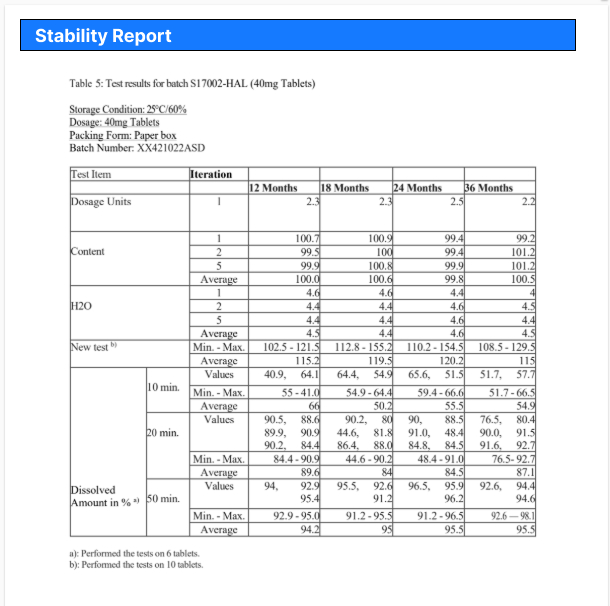
Stability_Doc

Feed stability reports by email, ftp or upload into a unified workflow

ML-powered models extract and classify information and attach context (metadata) 

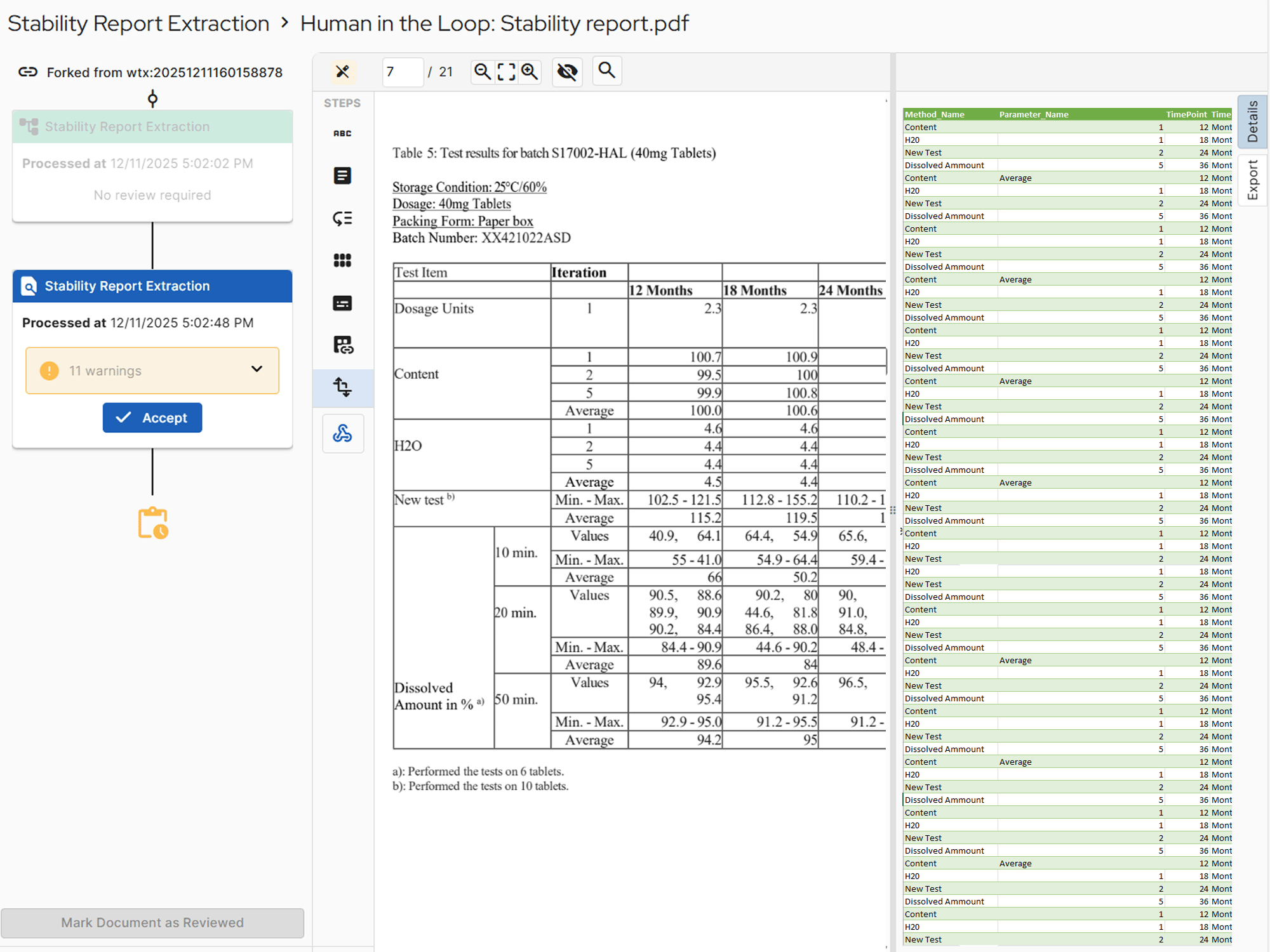
Configurable human-in-the-loop validation ensures quality and enables further actions

Use simple chat interface to search, compare and analyze the Reports 

Feed the structured data from the Stability Reports into downstream systems 

How does smart automation on Stability Reports work?

Stability_DataPoints (1)

Tailored models extract data from the Reports and attach context

Dedicated Machine Learning models identify and extract key measurements from your Stability Reports, adapting to various formats and layouts.

Relevant context, such as document metadata and structure, are also attached, providing traceability and reliability in further processing steps.

Quality experts validate the content and trigger next steps

Configurable business rules can transform the test results and adapt it to your specific needs and systems.

Review-by-exception workflows let experts quickly validate results, tag colleagues and approve the output.

This ensures that only validated test results move forward, with action logs for GxP compliance and streamlined audits.

Stability_Review
Stability_Workflow (1)

Integrate Smart Test Result Extraction into your Overall Quality Process

Visual workflow orchestration enables flexible reuse of extracted data. Moreover, ensure all downstream systems are catered with verified and high-quality test results.

The data can be sent to your systems automatically via APIs for compliance tracking or further analysis. 

Based on machine learning models tailored to Quality & Regulatory needs

Picture5

Highest accuracy for complex documents, through document & table specific models

Models are fine-tuned on your data for precision and privacy. Your models, your data.

Human-in-the-loop interfaces to ensure validity and compliance of data and models

Traceability back to the source, for auditing and versioning, and avoiding the risk of hallucination

Get in touch with us today

1 platform, many solution

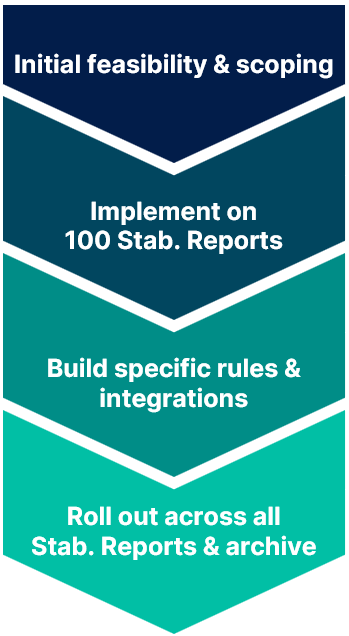
Timeline - Stability Reports

Breaking down complexity in steps:

 1/ Initial feasibility and scoping: 3 weeks

  • Running test documents
  • Aligning on objectives and implementation

2/ Implement the first solution: 1 month

  • Implement solution on first 100 Stability Reports
  • Configure rules and actions 

3/ Improve the solution: 2 months

  • User feedback to improve the configuration
  • Define path and integration for scaling-up

4/ Roll out across products: 6 months

  • Build integrations and train users
  • Roll-out across sources and teams

Typical industry challenges

close-cross-symbol-in-a-circle

Manual document extraction & review takes hours and is error-prone.

close-cross-symbol-in-a-circle

Searching the history is tedious and provides document, not analysis

close-cross-symbol-in-a-circle

LLM based solutions do not provide the reliability required in GxP environment

close-cross-symbol-in-a-circle

Our data is too sensitive to be shared to external systems

How we solve it

checked

Automated extraction provides instant and reliable data on 1000s of docs

checked

Easily search and analyse the data thanks to prior structuring steps

checked

Sector specific machine learning models provide accuracy & traceability

checked

Dedicated models run on a dedicated instance. Nothing is shared.

What Do our Customers Say about Acodis?

Really a great product, very versatile and easy to use. But above all thanks to the technical assistance that responded quickly and competently to all our questions. Absolutely recommended.
Dean Wheeler
Co-Founder & CEO, AcclaimWorks
Great framework. It helped us automate our website creation & maintenance, and made it faster and easy. Highly recommend.
Brad Kirkland
Chief Executive, YetiTech
Great theme, awesome design and very easy to use. Lots of great modules that can be edited and styled to fit your brand. Just as impressive is the support that comes with it.
Andrea Ricci
Business Development, Weerg
Great framework. It helped us automate our website creation & maintenance, and made it faster and easy. Highly recommend.
Joe Peter
Co-Founder, VP of Product & Design, Engageli
Great theme, awesome design and very easy to use. Lots of great modules that can be edited and styled to fit your brand. Just as impressive is the support that comes with it.
Olivia Miller
Marketing Manager, House of Revenue
Really a great product, very versatile and easy to use. But above all thanks to the technical assistance that responded quickly and competently to all our questions. Absolutely recommended.
Olivia Hu
Media Specialist, Markezing

Certifications & Data Privacy

 
2024_03_MA_ISO Certificates
 

Get in touch with us today

1 platform, many solution

Frequently asked questions

Why would your models understand our Stability Reports better than state-of-the art Copilot or OpenAI LLMs?

Whilst LLMs are trained on the global web content, our models are trained specifically on quality and regulatory documents. When our system ingests a Stability Report, it will run 15 separate models, each trained to understand specific components of the document with accuracy (titles, tables, footnotes, etc.). 

As these models are proprietary to Acodis, it is much more cost effective and traceable than systems relying purely on external LLMs.

Finally, our system can also integrates LLM post-processing, so clients actually get the best of both worlds !

Concretely, what do I get out of the system in a few weeks?

In a couple of hours we can setup a dedicated instance and run our standard models on your Stability Reports . With 20 to 30 processed  documents, you have a first version of a model adapted to your needs.
You have the possibility to extract key information and query the Stability Reports through an interface similar to Chatgpt, enabling you to answer any questions, get summaries and draft pieces of content. Always with the access on-screen to the source document. So you can make sure that the output is conform to the actual content. 

Within a few weeks, we can work further on the patterns of your documents, further train models with 100 Stability Reports and create outputs that address your business needs in a more automated fashion.

Does Acodis support GxP compliance and validation requirements?

Yes. Acodis is built to support GxP-regulated environments and aligns with GMP-compliant documentation requirements. The platform ensures traceability, complete audit trails, version control, and robust data integrity — all critical for regulated processes.

What types of documents and formats can Acodis handle, including handwritten or scanned files?

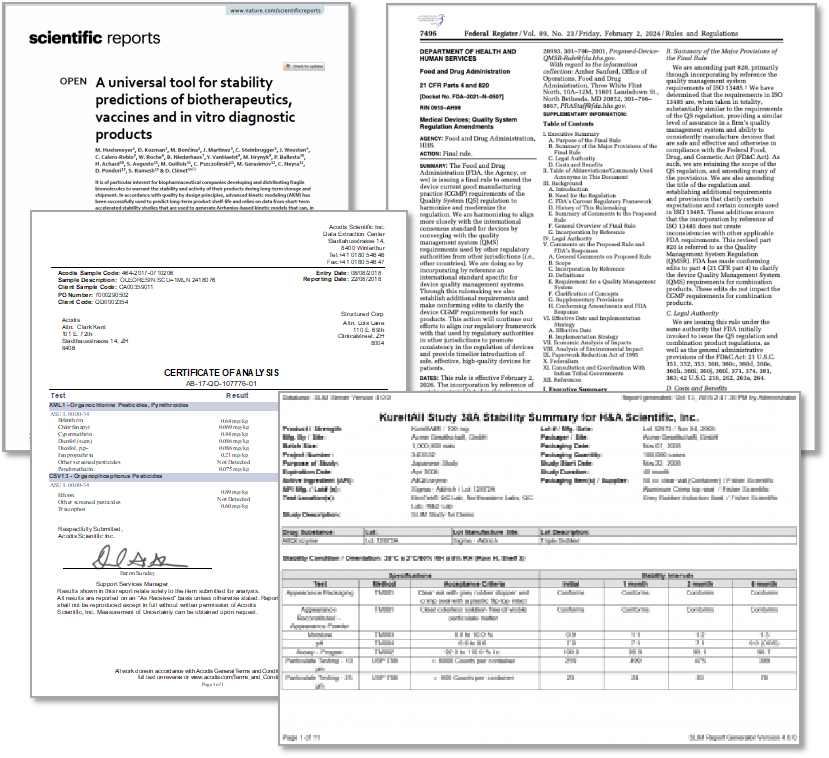
Acodis can handle a broad range of document types, including PDFs, Word files, Excel sheets, PowerPoint decks, scanned documents, images, & even handwritten text. Whether your documents are structured, semi-structured, or entirely unstructured, Acodis extracts the relevant data accurately. Even from complex formats like tables, multi-page reports, or low-quality scans.

Can Acodis integrate with our current systems (like LIMS, QMS, ERP)?

Yes. Acodis integrates seamlessly with existing enterprise systems such as LIMS, QMS, ERP, and other document or data platforms. As a SaaS solution, it supports flexible integration options including REST APIs, FTP, and other standard protocols, whether you're working in a cloud, hybrid, or on-premise environment.