
Document Chunking for Regulatory and Quality Teams in Life Science

Chunk and structure documents and data into reusable components, with every piece traceable back to its source page, to feed LLM drafting tools, data lakes and analytical databases. This enables reliable reuse of documents and product information in pharma and life science.

For Quality and Regulatory Teams Sitting on Thousands of Approved Documents

Every pharma company gets masses of data and documents. The question is how to turn them into content that can be reused and searched reliably, and how to know where a reused passage came from. Putting it all on SharePoint and plugging an LLM on top does not answer that.

The typical status quo and challenge for Life Science companies:

The documents sit on SharePoint

Studies, SOPs and quality reports are written, approved and filed. As finished PDFs they are readable for people and closed for everything else, so none of that content is reusable as it stands.

An LLM gets plugged on top

The model receives pages, not content. A stability table loses its header row, a value loses its unit, a paragraph loses the section it belonged to, because nothing told the splitter what kind of document it was reading.

The answer lack on accuracy or on traceable sources

It reads plausibly and nobody can check it. Without a reference to document, version and page, every output gets verified by hand, and the time the team set out to save comes back at the end.

Working in one of those teams? Quality Management · Regulatory Affairs

The Missing Piece for Reliable AI: Acodis Turns Documents Into Reusable, Traceable Chunks of Data

You get chunks: structured components of your documents that carry their metadata, their section context and a reference back to the source, exported as XML, DITA or JSON into the systems you already run. That output is what puts us between two kinds of tools teams already know.

Extraction and labeling tools

What it does

Pull defined fields off a page and hand you a value, for example a batch number or a result.

Where it stops

Stops at the field. The rest of the document stays a PDF that nothing downstream can use.

Acodis

What it does

More sophisticated extraction, plus a transformation of the content into chunks that carry metadata, context and source.

Where it stops

Hands the chunks to the systems you already run. We do not draft. We provide reliable context.

LLM drafting tools

What it does

Generate quality and regulatory text from whatever content they are given.

Where it stops

Only as reliable as the content behind them. Exactly that context is Acodis delivering.

Not a generic chunking tool

  • Tables and units stay intact, with the header row and the footnotes attached to the table they belong to
  • Section and heading context travels on every chunk, so a passage keeps its meaning outside its document
  • A source reference on every chunk, down to document, version and page
  • Models trained per document type, instead of layout heuristics applied to everything

Traceable Chunks, Clean Downstream Content, Faster Regulatory Drafting

Left, a clinical study report page with its components recognized. Right, what that changes for the systems and the people working after you.
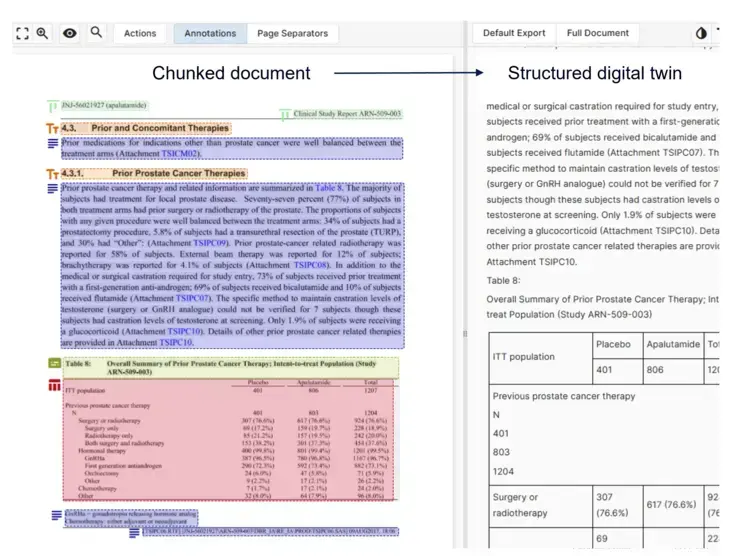
Clinical study chunking (1)

Reliability and traceability

Creates reliability and traceability in LLM processing (generation) or structured authoring, because every chunk can be followed back to the page it came from.

Clean content downstream

Feed downstream LLMs, knowledge graphs or authoring platforms with deduplicated and clean content, instead of raw pages that were never meant to be machine input.

30% faster regulatory drafting

The setup enables a 30% speed up of drafting regulatory documents. That is what we achieved for multiple Life Science and Pharma clients already.

Knowledge graphs and enterprise search

A global pharma team reuses product and CMC information from approved documents for its knowledge graph and search, with every entry traceable to its source.

Rated by the Best

Global leaders in the pharmaceutical, manufacturing, and chemical industries trust Acodis. Source: Reviews on G2.com
DataPreparation_HighPerformer_HighPerformer
DataExtraction_EasiestToDoBusinessWith_EaseOfDoingBusinessWith
IntelligentDocumentProcessing(IDP)_BestSupport_QualityOfSupport
users-love-us

With Acodis' Deterministic Models All Components Are Traced Back to Their Source

Acodis extracts and chunks your documents into reusable components. Where the chunks go next stays your decision.

Done by Acodis

Extract and structure

Text, tables and footnotes, with page and position.

Chunk and contextualize

Meaningful components with section, version and source.

Your systems, your choice

Data lake and analytics
RAG and AI search
Knowledge graph
LLM-assisted drafting
Structured authoring (DITA)
Source document, page, section
traces back to
Drafted sentence

Every chunk carries its source. Every drafted sentence stays one click from the evidence.

What runs in the chunking step

  • Content from various input channels, including legacy documents, is chunked into smaller, structured components with metadata, context and source
  • Business rules can be applied to enrich content
  • Duplicates and near-duplicate identification
  • Chunked data is exported in XML, also DITA, or JSON to downstream systems

Input via APIs and drop-ins, in flexible formats. Also available: FHIR standard.

Read the full framework on AI-ready data

Get in touch with us today

One platform for your dream solutions

Based on Machine Learning Models Tailored to Quality & Regulatory Needs

GxP Compliant Machine Learning Models

GxP compliance by design, providing full traceability, auditability and replicability in compliance with 21 CFR Part 11 and the EU Annex 11

Highest accuracy for complex documents, through document & table specific models

Models are fine-tuned on your data for precision and privacy. Your models, your data.

Human-in-the-loop interfaces to ensure validity and compliance of data and models

Traceability back to the source, for auditing and versioning, and avoiding the risk of hallucination

AI in Pharma Quality & Regulatory teams: The Report

Where pharma teams automate first and what results they measure.

GET THE REPORT

What Chunking Changes on Your Own Studies and Quality Documents

Acodis is not a generic chunking tool, it structures content for regulated work. Every model is trained for the document types your teams actually work with, every chunk keeps its source reference, and GxP compliance is part of the architecture. That is why these results hold up in regulated environments:

  • Deterministic models
  • Enhanced accuracy and data integrity
  • GxP compliance by design

80%

less human review time on clinical studies

Acodis clinical study deployments

4x

speed, accuracy and data depth on complex tables

Clinical trial study project

up to 95 %

time saved compared to traditional document chunking

Customer-reported, RAG pipeline ingestion

hours

to a dedicated instance running on your own studies

Acodis implementation practice

Want numbers like these for your own documents?

BOOK A DEMO

Customer Success Stories

Four client projects, from complex clinical tables to thousands of laboratory test reports.

4x

Unlocked insights from clinical trial studies

Providing 4x speed, accuracy and data depth in data extraction of complex tables.

“Acodis allowed for the data to be extracted without the use of manual hard coding each page.”

95%

Faster data ingestion for RAG pipeline

95% of time savings compared to traditional document chunking.

“We would not be in the GenAI business as we are now without structured data coming from high-value documents. Acodis is unique in the way they do it.”
3x

Accelerate data collection from test reports

Providing 3x more data with 90% less time on 9,000 laboratory test reports.

“This saves us a significant time, drastically reduces the risk of errors and automates the workflow.”

Search & analyse quality contracts history

High-performance document research with tailored outputs.

“High-performance tool for rapid document research and analysis. A consistently reliable partner for the long term.”

Phased implementation is the key for a quick ROI and long-term scalability

4 step process

Breaking down complexity in steps:

1/ Initial feasibility and scoping: 3 weeks

  • Running test documents
  • Aligning on objectives and implementation

2/ Implement the first solution: 1 month

  • Implement solution of a first product
  • Configurate rules and actions 

3/ Define implementation: 3 months

  • Take user feedback to improve the solution and configuration
  • Define path and integration for scaling-up
  • Validate the solution

4/ Roll out across products: 3 months

  • Build integrations and train users
  • Roll-out across products and teams

Talk to Us About Chunking and Structuring Your Studies and Quality Documents

  • See Acodis chunk your own studies, SOPs or quality reports
  • Get an honest assessment of which document types fit
  • Leave with clear next steps, formats and timelines

Tell us which documents you want to reuse and we will get back to you.

Contact Us

Frequently Asked Questions

What is document chunking?

Document chunking is the process of splitting a document into smaller passages, called chunks, that still make sense on their own. Quality and regulatory teams often call the same step content structuring or componentization. With Acodis each chunk keeps the context it needs, such as its heading path, its table structure, its units and a reference to the source document, so it can be retrieved, reused or handed to an LLM without losing meaning. For clinical studies, SOPs and quality documents this is what makes reuse safe: a chunk without its context is just text, and text without a source cannot be checked.

What is the best chunking strategy for clinical studies and quality documents?

Acodis starts from the structure the document already has, so sections, subsections, tables and footnotes stay together, and every table is kept as one unit instead of being cut across chunk boundaries. Around 15 specialised models run per document, each trained on a specific element such as titles, tables or footnotes, and business rules are applied for the specific document type. Where it helps, LLM post-processing can be added on top.

How do you chunk a PDF for RAG without losing the tables?

Detect the table as a table before chunking, and keep it as one chunk together with its caption, header row, units and footnotes. Acodis runs specialised models per document element, so a table is recognised, reconstructed with its rows and columns and then chunked as a whole. Values keep the unit and the column they belong to, which is what stops a retrieval pipeline from returning a number that means something else.

How does Acodis keep traceability from a reused sentence back to the source?

Every chunk carries the identifier of its source document, the version and the page or section it came from. That reference stays with the chunk when it is exported, so whatever your downstream system generates can be linked back to the exact place in the original file. Reviewers check the evidence instead of re-reading the document, and audits get the trail they expect.

Which output formats do you deliver?

Chunks are delivered as XML, including DITA, or as JSON, and where a standard applies we map to it, for example FHIR in health data contexts. Delivery runs through an API or a drop-in folder into your data lake, search index, RAG pipeline or authoring platform. Input is equally flexible: PDFs, Word files and other formats from the sources you already use.

Do we need an Acodis drafting tool to use this?

No. Acodis does the chunking and hands the chunks over to the systems you already run, whether that is your data lake, your RAG stack, your LLM or your authoring platform. We are not a drafting tool. Faster drafting is the outcome of clean, traceable content, not a product we put in front of your teams.

How fast can we start, and how much setup does it take?

In a couple of hours we can set up a dedicated instance and run our standard models on your studies. Around 15 specialised models run per document, each trained on a specific element such as titles, tables or footnotes, so you get usable chunks before any tuning has happened. Within a few weeks the models and rules are adapted to the patterns of your own documents.

Is document chunking with Acodis GxP-ready?

Yes. Acodis is built for GxP-regulated environments: deterministic models, full audit trails, version control and traceability back to the source, with human-in-the-loop review where judgement is needed. Every client runs on a dedicated instance. Your models, your data.

What is the difference between document chunking and data extraction?

Data extraction pulls defined fields out of a document, for example the batch number or a result value on a certificate of analysis, and hands you a record. Document chunking keeps the document as content: it splits the whole file into passages that stay meaningful on their own, with their tables, section context and source reference attached. Extraction answers "what is the value?", chunking answers "which content can we reuse, and where did it come from?". Most teams end up using both, see our data extraction use case.

Can chunked documents feed a knowledge graph?

Yes. Each chunk carries structured metadata such as document type, section, product, version and source page, which is what a knowledge graph needs to create entities and relations. Pharma teams use this to connect product and CMC information across approved documents and make it searchable, with every fact traceable to its source. Acodis delivers the chunks, the graph runs in your own stack.